

Most people treat journaling as a matter of inspiration: the right notebook, the right mood, deep thoughts that flow. But a daily journaling habit isn't built on inspiration — it's built by making the behavior absurdly small, anchored, and visible. Here's how to do it with the don't-break-the-chain method.
Why most journaling attempts collapse
Half-finished notebooks in a drawer all share the same story. The target is too big ("I'll pour out a full page every night"), there's no trigger (it's never clear when you'll write), and progress is invisible — a good week and a bad week feel identical. You skip once, then again, and the notebook gathers dust. The problem isn't discipline. It's structure.
Start with two or three sentences
The most reliable move is to shrink the goal until it's almost embarrassing. Two or three sentences. Short enough to do on your most exhausted, over-scheduled day.
In Daychain, add journaling as a binary task: you either wrote or you didn't — no grey zone. One tap forges the link. In the early weeks the goal isn't to write well; it's to open the notebook every day. Almost nobody stops at exactly two sentences — the hard part was opening the page.
Anchor it to a cue: morning coffee or bedtime
A habit needs a trigger to hang on. Instead of "write more," bolt journaling onto something you already do automatically:
- After I pour my morning coffee, I write three sentences.
- After I brush my teeth, I put the day on paper.
- Before I get into bed, I close the day in one paragraph.
The words doing the heavy lifting are "after" and "before." You already make coffee and get into bed without thinking. Chaining a new behavior onto an old one borrows that automaticity instead of relying on memory. Leave the notebook in the path of the trigger too — on your pillow, beside the coffee machine.
Don't break the chain
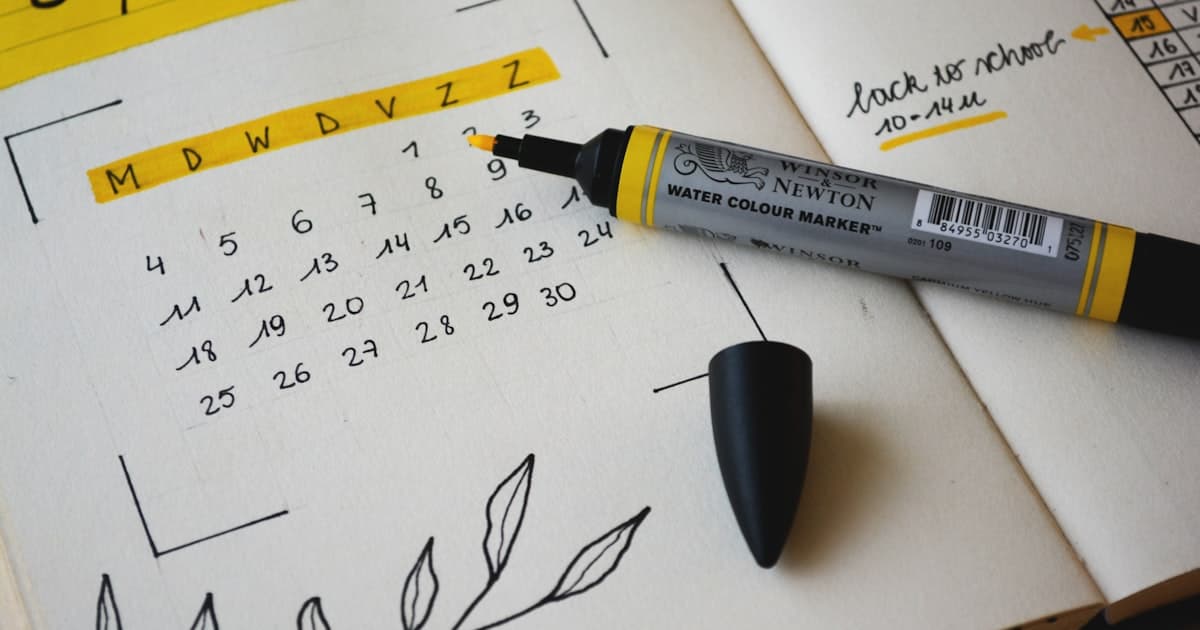
This is the method that gives Daychain its name. The idea is often credited to comedian Jerry Seinfeld: hang a big calendar on the wall, and for every day you do the work, mark a large X. After a few days you have a chain; after a few weeks, one you don't want to break.
The chain works because it flips your motivation. You stop asking "do I feel like writing tonight?" and start protecting a streak you've already built.
Every day you write, a link is forged. The visible, growing chain becomes its own reason to keep going — make it the first thing you see when you open the app.
Prompts to beat the blank page
The real source of the block isn't laziness — it's the uncertainty of "what do I write?" A few fixed questions erase that uncertainty. When you're stuck, pick one:
- What drained me today, and what eased it?
- What am I grateful for — even something small and ordinary?
- What's my one priority for tomorrow?
- What did I learn about myself today?
Your sentences don't have to be literary. The goal is to get the thought onto paper; polish comes later. Asking the same three questions every day turns writing from a decision into a routine.
When you miss a day: the planned skip
You will miss a day — a meeting that runs late, a sick child, an exhausted evening. A habit is defined not by whether you slip, but by what you do next. The rule that matters: never miss twice in a row.
Daychain builds this forgiveness in on purpose. If you want to stay in strict mode, a planned weekly skip protects the day; switch to balanced mode and an honest slip is covered automatically, so a single bad day doesn't erase weeks of links. The day after a miss, don't try to "make up" for it with pages — write two sentences and keep the chain alive.
A simple starter plan
- Days 1–7: Write three sentences right after a fixed trigger. Mark the binary task. That's the entire goal.
- Days 8–21: Keep the same trigger, but let the entry stretch to wherever it naturally wants to go. Don't force it.
- Days 22–30: Look at the chain. You now have three weeks of links. Journaling is no longer a decision you make each night — it's just what you do.
By day 30 you won't be trying to journal. You'll be someone who forges a chain — and reaching for the notebook will feel less like effort and more like coming home.